
May 13, 2026, to May 7, 2027
The exhibition is co-curated by Dr. Jimil Ataman and Dr. Anne Bissonnette.
Old Hat
Men’s Head Coverings 1700-1960
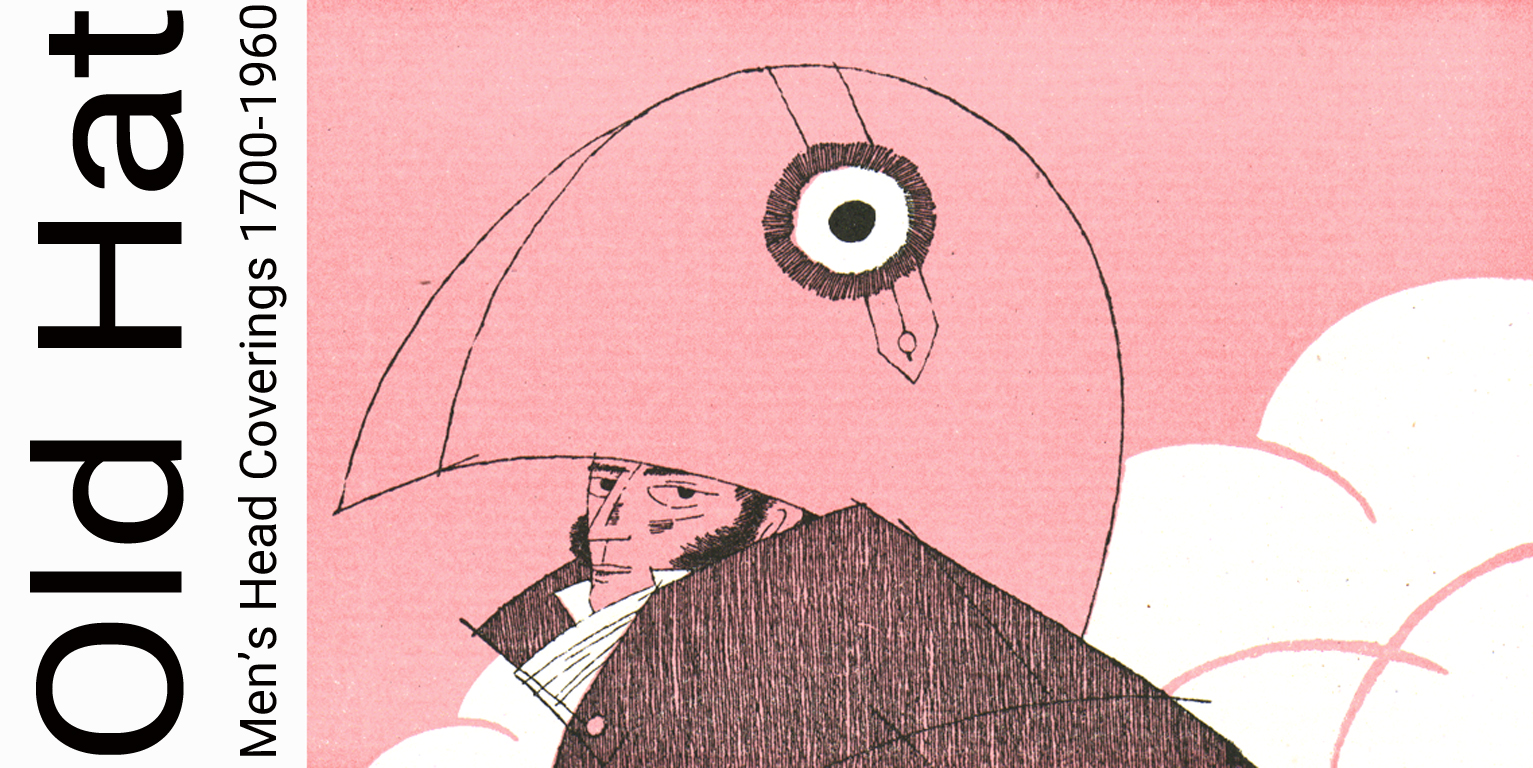
In the past centuries, numerous hats were donned by men that were appropriate for specific contexts. In the eighteenth century, when most elite men shaved their heads and wore wigs, fancy “night” or “undress” caps could be worn with elaborate dressing gowns at home. Many gentlemen received guests so attired and chose to be featured in portraits in this state of “undress.” Headgear worn in public in the daytime in the state of “dress” and “full dress” evolved from the eighteenth-century felted fur cocked hat with its wide brim turned up on three sides (“tricorne”) or two sides (“bicorne” – visual above). The materials, crown shape, size and brim treatment and the decorative schemes used led to a variety of distinctive headwear. When mercury was used in the felting process, “mad hatters” could suffer neurological damage to create valued coverings that were expected at different times of day.[1]
Head coverings could run the gamut from casual to formal. The dome-shaped “bowler,” invented in 1850 for gamekeepers and later adopted in the 1880s by city gentlemen and working men, was not interchangeable with the flat-crown and wide-brim straw “boater,” worn for leisure.[2] The “top hat” migrated from day to evening dress in the nineteenth century. As top hats could be cumbersome, the “gibus” was a collapsible style invented in the 1840s that could be taken off and carried under the arm when flat.[3] Hat etiquette endures to this day with men expected to remove their hats indoors yet “allowed to keep their hats on as they travel through transitional spaces,” such as lobbies and corridors.[4] Then and now, wearing a hat that is outdated or used in the wrong social context might suggest you are rigid, no longer interesting or socially inept – and get you called an “old hat!”
Jimil Ataman, PhD
Anne Bissonnette, PhD
_____________
[1] “What is Mad Hatter Disease (Erethism)?,” Healthline, www.healthline.com/health/mad-hatter-disease.
[2] Ariel Beaujot, “‘If you want to get ahead, get a Hat’: Manliness, Power, and Politics via the Top Hat,” Journal of the Canadian Historical Association 25, no. 2 (2014): 59. https://id.erudit.org/iderudit/1032841ar.
[3] Valerie Cumming, Cecil Willett Cunnington and P.E. Cunnington, The Dictionary of Fashion History (Oxford, New York: Berg, 2010), 92.
[4] Judith Martin, Nicholas Ivor Martin and Jacobina Martin, “Miss Manners: Men can keep hat on indoors,” The Mercury News (San Jose, CA), November 5, 2013, https://tinyurl.com/4px8fkkj.
Ch. Martin visual from George Cecil, “L’histoire des favoris,” Gazette du Bon Ton 3, no. 8 (1920): 153.
Communicating Identity
Fashion scholars have argued that what we wear functions as a communication system.[1] In these two display cases, hats convey a person’s group identity. Nonetheless, military headgear went beyond the collective or mere function and could express personal rank and title. The ordinary World War I soldier would be sent to front line trenches with the metal Mark I helmet to shield off artillery and mortar fire.[2] By World War II, an officer in the Royal Canadian Artillery would wear their “field service cap,” or “wedge cap,” as a way of showing their elevated rank when off-duty.[3] For those who served as staff officers, a more structured and impressive “service dress cap” would be donned. While the language of military rank is clearly conveyed through insignia located on the shoulders, sleeves or collar, the shape of one’s headgear also spoke volume.
Occupational hats also communicate social identity. When cars were novel and denoted status, special tan motoring caps that would hide the dust of unpaved roads were worn by both men and women.[4] Another type of fellowship through dress is the elaborate red fez hat of the Shriners International. Started in 1872, this organization conveyed through headwear their “good humour and wit.”[5] Today, their use of the fez – which ignores the religious and cultural context of this distinctive hat – has been questioned.[6] Closer to home, nothing says Alberta quite like the classic cowboy hat!
_____________
[1] Roland Barthes, The Language of Fashion, trans. Andy Stafford (Oxford, New York: Berg, 2005), passim, https://archive.org/details/languageoffashio0000bart/page/n5/mode/2up.
[2] Supply Line Artifact Backgrounder, “Mark I Helmet,” Canadian War Museum, https://tinyurl.com/3jdxvhbj.
[3] “The Field Service Cap in the Canadian Army,” https://tinyurl.com/3aj5jm2x.
[4] “The Early Automobilist Fashion Was Made Up of Heavy Coats and Goggles: Photos From 1900-1910,” Rare Historic Photos, https://rarehistoricalphotos.com/vintage-automobilist-fashion/.
[5] “Shrine History,” Al Azhar Shriners of Southern Alberta, https://tinyurl.com/k5x4kc8n.
[6] Mark Juergensmeyer and Wade Clark Roof, eds., Encyclopedia of Global Religion (Los Angeles: Sage Publications, 2011), s.v. “Fez,” by Christopher M. B. Allison, https://tinyurl.com/m28fxr4j.
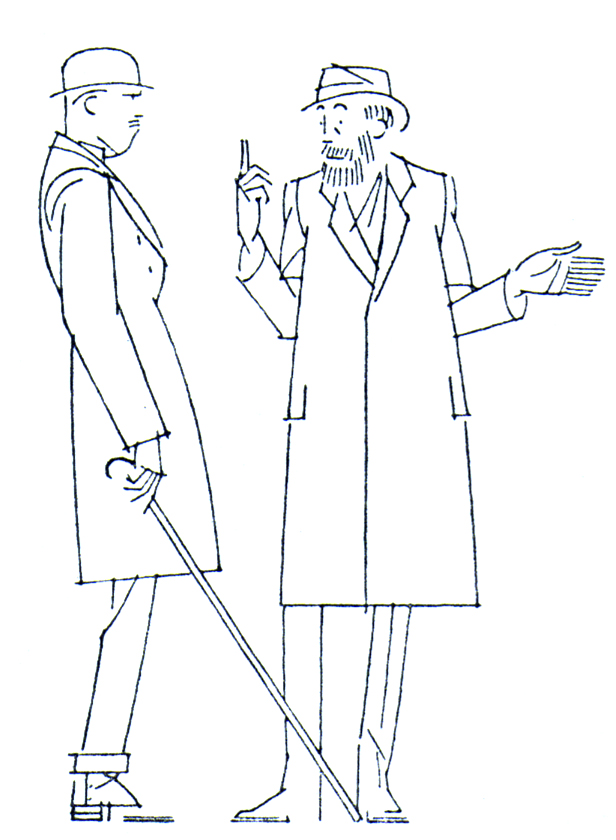
Bernard Boutet de Monvel visual from Henri Bidou, “La peinture absolue,” Gazette du Bon Ton 3, no. 2, (Mars 1920): 39.